A word of warning: This is just what the headline says – first and foremost a little rant. A rant about what Second Life is, and what it could be.
Thomas Praus, Max Senges and I have been chatting about Second Life quite often lately. So we decided to each take a stand, and give a judgement, on what we think is the deal with Second Life (SL). So here’s my part of the deal – you can read Max’s here. (I’ll link to Thomas’ once he posted his.)
Second Life (as it is: bad)*
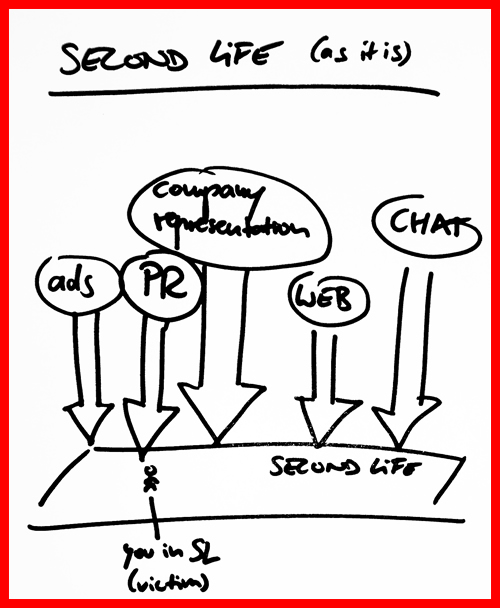 * I took a clue from Kathy Sierra and tried to provide a kind of visual summary of my ideas here. However, I’m not as avid a painter as she is. Please bear with me.
- SL as just another distribution channel for the same old stuff
- “just dump it there, users will come”
- users as victims, isolated, passive
- “we need to be the first there to make the quick bug”
Second Life (as it could be: great)
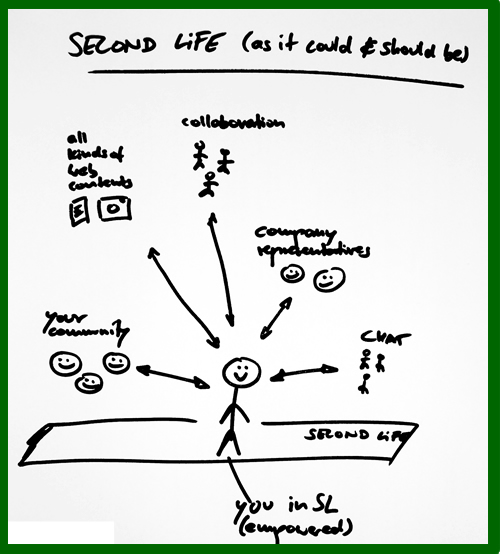
- feels human
- Second Life as a platform for collaboration, enabling interaction
- Second Life as a user interface to access and control all kinds of stuff
- “let’s build it together from scratch”
- community-driven
- enabling & empowering users
And here’s my actual rant:
Hype or bashing: The way Second Life is discussed in the media reminds me a lot of the way the web was discussed in the early and mid-90s: Either bashing or hyping, but hardly any reflexive thinking in between. It’s all black or white, and it’s along very similar dimensions, too: economic opportunities; democratization & participation; marketing; privacy or lack thereof; or globalization. Either, Second Life is treated as a revolutionary, futuristic Utopia that will help solve the world’s problems, or at least provide massive economic growth. Or alternatively, critics claim that Second Life will bring the demise of culture as we know it – with arguments ranging from fostering escapism or child pornography to depriving us of our last bits of privacy.
Most journalists don’t really seem to know what they’re writing about, or maybe they just assume their readers won’t know, so they have to boil it down (and go way too far). Sadly, too often these articles come across as just an excuse to put virtual boobs on the cover, even if the pictures don’t even half match the content of the article.
Second Life as a platform: The chances of Second Life are in its being just a platform onto which basically everything can be projected: All kinds of content (in-game content as well as all kinds of audio, video, text, code), all kinds of social interaction (collaboration, socializing, meetings, chats), and plenty of things we haven’t even thought of yet – it can all be projected onto the white screen that is Second Life. That’s where its great potential is: To provide a visual interface to other kind of data. (Where technical standards (or lack thereof) prohibit this, Second Life has to change or it will be simply replaced by the next, more open platform.)
In his mind-boggling book The Wealth of Networks, Harvard Law professor Yochai Benkler says:
Like other massively multiplayer online games, Second Life is a persistent collaboration platform of its users. Unlike other games, however, Second Life offers only tools, with no story line, stock objects, or any cultural or meaning-oriented meaning whatsoever. Its users have created 99 percent of the objects in the game environment. (…) Second Life sees the users as active makers of the entertainment environment that they occupy, and seeks to provide them with the tools they need to be so. The two models assume fundamentally different conceptions of play. whereas in front of the television, the consumer is a passive receptacle, limited to selecting which finished good he or she will consume from a relatively narrow range of options, in the world of Second Life, the individual is treated as a fundamentally active, creative human being, capable of building his or her own fantasies, alone and in affiliation with others.
Performance: There are so many articles about Second Life that you’d think that half the population is active in Second Life – which clearly isn’t the case. Despite about 4 million registered users, hardly ever are there more than 30,000 to 35.000 users logged in at the same time. Word on the web has it that this isn’t so much due to lack of interest, though, but due to technical issues: Linden Lab’s servers, it is whispered, can’t take more load than those 35.000 users produce.
Linden Lab has to find a way to improve performance, and in the order of several magnitudes. Even with slow growth, SL can’t cope with the traffic and rendering, and with the exponential growth to be expected, Second Life will just implode. Restricting access isn’t an option for the obvious reason that it’d mean the end of Second Life. Same goes for making it a premium, paid service. The only way I can see that would work here is to open-source it.
Open-sourcing SL would mean to lose control over the platform. While this is a scary thought for Linden Lab, we’ve seen it work before on the web, many times. Mostly, it’s turned out great.
Ownership: Issues of ownership must be solved: How can users put in their stuff, cash, code, items, and how can they safely get them back out? (See my post here, or even better: Onder’s post for more thoughts on that.) MAKE’s Owner’s Manifesto goes here as well: If you can’t open it, you don’t own it.
Governance: The rules of engagement within Second Life are more than instable: Just relying on Linden Lab’s terms of service, which “Linden Lab may amend this Agreement at any time in its sole discretion”, will ultimately deter users from real engagement, and certainly from significant investments. Same goes for the Community Standards, which are a nice set of rules: It’s a non-enforceable set of rules, the infamous toothless tiger that political science literature likes so much to refer to. So who sets, and who enforces any kind of rules? What kind of mechanisms are in place to resolve conflicts?
As long as Second Life positions itself as a game, there’s no need to find a decent form of governance. However, if it tries to be a platform for massive interaction on a social, economic and creative/productive level, governance becomes key. So far, there’s no real development to be seen. About a year ago, in February 2006, Linden Lab’s marketing director Catherine Smith told me that “our goal is to give our Residents the tools they need to handle abuse themselves.” While self-governance is fine as an ideal, in this case it seems more like an excuse not to get involved. Not much seems to have changed, although a vague warning of “Suspension and eventually Banishment” are mentioned by now in the community guidelines, along with “In-World Representatives, called Liaisons, [who] may occasionally address disciplinary problems with a temporary removal from Second Life.” This still has a long way to go.
So far, those are the main issues I have with Second Life. While there is a huge potential in this virtual world, it is just that: A potential that hasn’t been realized. Without some massive changes, it may never be – other virtual environments will emerge quickly. And they’ll give Linden Lab a tough run for their money.
Link to Max’s post.
Update: Onder just told me in the comment section that he simultaneously posted about, quote: “The demise of Second Life”. Thanks for the hint, Onder!


5 Comments
The ironic thing here: I got your pingback on my blog JUST as I clicked the Publish button on an article entitled “Contemplating Second Life’s Demise”. :) See it here: http://slgames.wordpress.com/2007/03/20/contemplating-second-lifes-demise/
I really like those sketches; they feel very warm and organic. Especially after seeing so many dry, PowerPoint-style (and the generic type at that, too!) charts that don’t illustrate points so well.
One think I should mention is Linden Lab’s internal team structuring has changed a lot, although it could stand to be a lot more obvious, e.g., I don’t think many know of our “Development Studios” unless you’ve met someone like Zero Linden during his inworld hours, and Liaisons are scaling to take on different specializations.
While rare, I hold such communities as Caledon in high-esteem for really doing it their way with “governance”. Other fine notables, let me know!
BTW, Groups 2.0 last year was part of “the tools”. Hopefully this year will see another round of Groups improvements, and I’m hoping some Open Source boffins will cook up useful anti-griefing tools. (Related, I’m impressed by Dale Glass’ TrustNet work.)
I’m mindful to view progress like money: there’s always more to be made.
Hi Torley,
Thanks a lot for your feedback.
It’s true, I really haven’t heard much about LL’s development studios. Could you point me to some info? I’m curious ;)
Also, to be fair, I didn’t mention one important point, which instead I left as a comment at Max’s post about the same issue. What I posted there is: “Agreed – Second Life is the best 3D virtual world so far, and Linden Lab deserves credit. Maybe I should have mentioned that in my answer. ;)” And so it is – so far I don’t know anything better than SL in terms of virtual environments, and LL deserve credit for this.
It just doesn’t seem to scale, or in other words: It feels like SL might have grown so fast, and overhyped so badly in the media, that the community kind might tip, that SL might be about to jump the shark.
But I’d be glad to be proven wrong – you think it’s all going to the right direction?
Btw. Your personal website is very cool – love it!
@Peter, you’re welcome! We don’t really have much formal info out yet about our development studios, but if you talk to Zero during an inworld office hour, he’d be more than happy to tell you. There’s this page of his with a terse definition:
» https://wiki.secondlife.com/wiki/User:Zero_Linden
And links to past transcripts!
In hindsight, some things are going to look different — remember those early videos about the World Wide Web from the mid-90s that seem so dated now? I think a lot of the current media coverage is going to be the same way. For me, the power in Second Life is sometimes not so much where it stands out, but where it blends in, ubiquitously, in very much the same way you’d enjoy a cup of coffee without necessarily buying into media hype (e.g., all the Starbucks articles over the years — that’s a parallel) or wear a pair of jeans.
The latter example is one which Steve Jobs has noted about the iPod, which is a popular technology which is now so commonplace that it doesn’t really cause shocked reactions so much as smiles and integrates into one’s “digital lifestyle”. I think there’s a solid case for Second Life to follow that as we grow too.
I think part of the problem for many people is that there’s not a single “direction”; Second Life is even more Resident-driven with community-created content than before, and many people have many different ideas about where they want it to go. And beyond that, many people are actually taking it in those directions as of their own accord, not Linden Lab’s. That is part of the problem with scaling, because we only have so many resources, but so many feature requests from people with conflicting goals — this is why I and you both mentioned Open Source, to help do things and make positive contributions to the world.
So I don’t think it’s all going in the right direction, but there’s also many gleaming promises, some of which have come to pass, which aren’t observed so much in the news. (Obvious things often get missed, I know of no major media articles to remark how much flexiprims have helped the economy via better clothes and hair.)
Like a baby stumbling on the way to walking, running, flying… how else does one learn? I really think a fundamental thing here is to endure, persist, and keep going, despite whatever is “said”. In a day where time is more of an infernal resource than ever before, a lot is written about SL by journalists who’ve only been in here for, what, a few hours, a few days at most? Or who haven’t been in SL at all but are writing it from the perspective of someone who reviews cuisine but doesn’t eat the food. That’s not representative of a life. So the most interesting press about SL to me is that which unfolds over time, which reexamines one’s past feelings about what’s happening. :)
Something that may seem “wrong” today may be very right tomorrow. History is littered with examples of technological predictions which seemed solid at the time but would fall apart years later. And terms that lose favor quickly: who still refers to the Internet as “cyberspace”. In a similar way how SL is often (and inaccurately, because that’s like saying “orange is the whole rainbow”) called again, I welcome perception-shifts, and reevaluating how and what we think about Second Life. As an online world constantly influx, it’s only fair, and sensible.
I hope for the same things many people want: being able to fit massive crowds in a region, smoother performance (higher FPS), etc. but I also hope for things not realy stated which are also extremely important, like an immersive sound experience. That hasn’t been brought up enough, but just about anyone who enjoys movies knows how vital audio is. It’s an intangible, a “feel good” which is tricky for anyone to define, which is why there’s frustration — but that is a catalyst for change and action!
And thank you very much re: my website! Have a lovely day.
Your writing skill is very nice and the post is very good.